
Just landed at Alicante Airport and heading for Calpe? Good news: it is an easy run, a little under an hour up the coast in good traffic, and you have plenty of ways to do it.
The right one really comes down to three things: what time you land, how much luggage you are bringing, and whether you are staying in the town centre or in the surrounding residential areas.
Here is the short version before we get into the detail:
| Detail | Answer |
|---|---|
| Distance | Around 77 km |
| Drive time | 55 to 70 minutes |
| Cheapest | The direct ALSA bus |
| Most flexible | A hire car |
| Easiest door to door | A private transfer |
Now let me walk you through each one properly.
How far is Alicante Airport from Calpe?
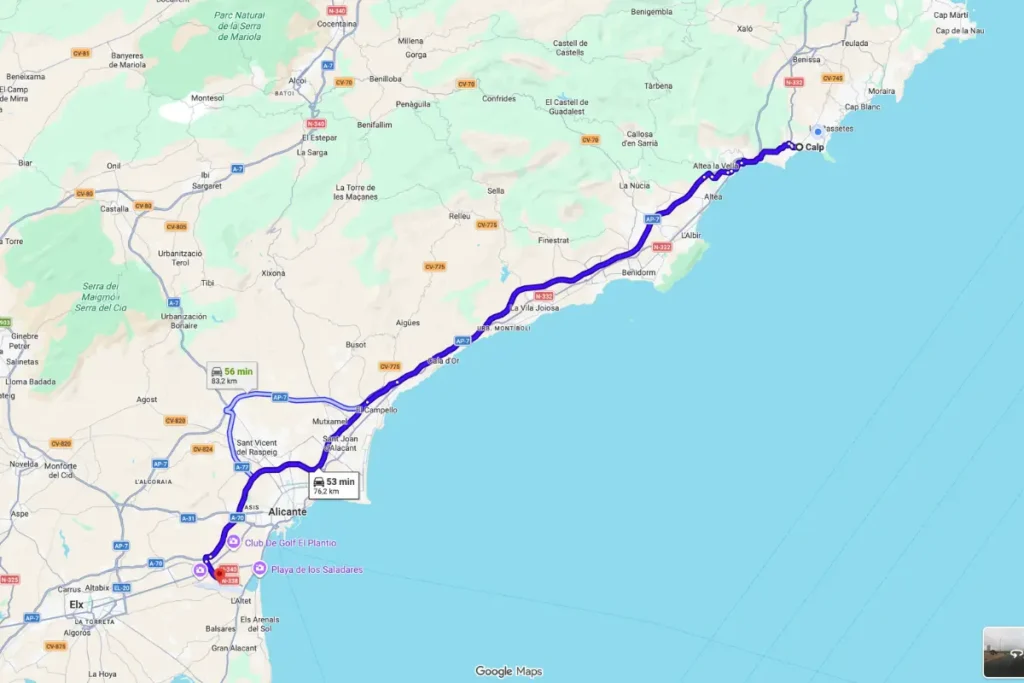
Alicante-Elche Miguel Hernández Airport is around 77 km south of Calpe, so you are driving north up the coast to reach us. In normal traffic that is around 55 to 70 minutes.
Land on a quiet weekday and you might do it in 55. Arrive on an August weekend and it can stretch to 75 or even 90, but more on that later.
The route nearly everyone takes is the AP-7 motorway towards Valencia, coming off at the Calpe and Altea exit. It is modern, well signposted, and as of late 2025 it is toll-free along this stretch, so there is nothing to pay and no booths to fumble at.
You can take the old N-332 coast road instead, which is the more scenic route because it follows the coastline through the towns along the way. It can be a nice drive if you are not in a rush, but it is usually busier, slower, and more affected by traffic lights and town traffic. For the airport run, the AP-7 is normally the easier choice.
Quick comparison of your options
If you just want the essentials, here is how each option compares on time, cost and convenience.
| Option | Time | Cost | Best for |
|---|---|---|---|
| Hire car | 55 to 70 min | €30 to €70/day | Flexibility |
| Taxi | 55 to 65 min | €100 to €130 | Fast and simple |
| Private transfer | 55 to 65 min | €110 to €150 | Families |
| Direct bus | 1h45 to 2h | €11 to €15 | Budget |
| Shared shuttle | 1h15 to 2h | From around €28 | Solo travel |
A few things to keep in mind as you choose:
- The bus is cheapest, but it will not take you to the door.
- A taxi and a private transfer take roughly the same time.
- A hire car costs more up front but pays you back across the whole stay.
- In peak summer, allow extra time on the road whichever option you pick.
Renting a car

If you are here for more than a few days, a hire car is the option I would point most people towards.
The drive itself is simple. Follow signs for the AP-7 Valencia and come off at Calpe and Altea. It is about as straightforward as Spanish motorways get, even if you have never driven here before. In high summer, give yourself extra time on Friday evenings and Sunday afternoons, when the whole coast seems to be on the move.
Before you book, a few things worth knowing:
- Basic insurance usually leaves you with a big excess. Full cover is worth it for the peace of mind alone.
- Pick your fuel policy with care. Full to full is the one that will not catch you out.
- In July and August the desks get busy when several flights land together, so pre-booking saves you a long queue.
- Parking in central Calpe gets tight in peak season, especially around Arenal-Bol and the old town.
Taxi from the airport
If you want to step off the plane and be at your holiday rentals door with no fuss, a taxi is a good option.
You will find the rank straight outside Arrivals on Level 0. Just follow the signs once you have your bags.
For 2026, budget around €100 to €130 for a taxi from Alicante Airport to Calpe. Daytime journeys are usually at the lower end, while late-night arrivals, Sundays, public holidays and heavier traffic can push the fare higher. The drive normally takes about an hour, depending on traffic and where in Calpe you are staying.
It makes sense when you are landing late, staying centrally, travelling light, or splitting the fare four ways. For a couple it feels steep next to the bus. For four, it is fair.
A couple of practical points: agree the rough fare before you set off, expect a short queue at the busy arrival waves in summer, and if you are getting in very late, a quick pre-book takes away any worry about availability.
The direct bus, ALSA
Travelling on a budget? The ALSA bus is the cheapest way up, and it runs straight from the airport to Calpe without dragging you into Alicante city first.
The basics: usually €11 to €15 a head, around 1 hour 45 to 2 hours, leaving from Floor 2 at the airport roughly every two to three hours.
It drops you at Calpe’s main bus station, near the centre. If you are staying around Arenal-Bol or in town, you can often walk from there. If you are staying in one of the urbanisations, you will want a Calpe taxi from the station to finish the trip.
Worth knowing: departures thin out late at night, summer buses fill up so it pays to book ahead, and if your flight is delayed you may be waiting for the next one. Luggage space is tighter than a car, too. Line the timetable up with your landing and it is a reliable, cheap run.
Shared shuttle transfers
A shared shuttle slots neatly between the bus and a private transfer. You travel in a minibus with other passengers heading to Calpe and the towns nearby, so it is more organised than the public bus without the price of a private car.
Expect from €20-€30 per person depending on the season. Beniconnect is one of the main operators along this coast.
How it works: book online, check in at the operator’s desk in arrivals, and you are pointed to your shuttle. It usually drops passengers at common drop-off points in Calpe rather than directly at each accommodation, so you may still need a short walk or taxi at the end.
Journey time depends on how many stops are ahead of you. In peak season, departures usually line up well with flights. In quieter months, you might wait a while for a vehicle to fill.
It is a good middle ground if you would rather not drive, but it is not the same as a private door-to-door transfer.
Private transfers
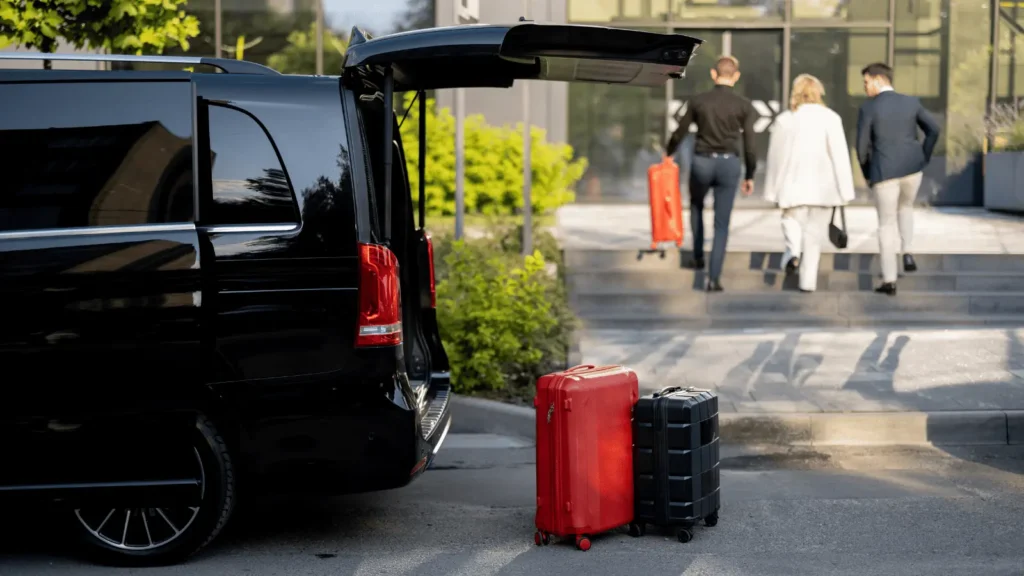
This is the comfortable one. Your driver meets you inside arrivals, takes the bags, and drives you straight to your accommodation. No other stops, no waiting on strangers.
Cost runs around €110 to €150 for a standard car, more for a minibus, and a touch higher at night or in peak season. The drive is about an hour, traffic depending.
It earns its money when you have kids in tow, a pile of suitcases, a late landing, or you are staying up in the mountains and would rather not navigate it for the first time. For four or more it can work out close to a taxi, with the bonus that your pickup is guaranteed.
Before you book, check the price covers airport pickup and luggage, make sure they track your flight in case you are delayed, and read the cancellation terms, especially in summer.
The things most guides skip
Prices are easy to list. It is the practical stuff that actually smooths the trip.
Peak summer traffic
Through late July and most of August, the coast gets busy and the road shows it. The usual pinch points are Friday evenings, Sunday afternoons, Spanish public holidays, and the mid-afternoon wave when a run of flights lands together. A drive that is normally 60 minutes can quietly become 75 or 90. If you are arriving in the thick of the holidays, build in the extra time and do not book anything tight at the other end.
Late-night arrivals
Land after 23:00 and your choices narrow. The direct bus barely runs that late, so it is usually a taxi, a pre-booked private transfer, or your own hire car. After midnight, book ahead. It is one less thing to think about at the end of a long travel day.
Mountain areas and residential zones
If you are staying in Maryvilla, La Canuta, Empedrola or any of the sourrounding urbanisations, public transport will not get you to the door. The bus stops in town, and you finish the journey by taxi. Plenty of these places come with steep, winding lanes and tight turns, so for a week or more your own car makes daily life a lot easier.
Luggage and the practical reality
Travelling with golf clubs, a pushchair, or three big cases between you? The bus can feel cramped, especially in summer. A taxi or private transfer is the kinder choice when you are loaded up.
There is no direct train
Just to head it off, there is no direct train to Calpe. You would have to go into Alicante city and connect, which is slower and more hassle than simply taking the bus or driving. The coastal TRAM does reach Calpe, but it runs between Benidorm and Dénia, not from the airport, so it is not part of this particular journey.
These are the details that matter more than the headline price. A little planning before you land is the difference between a smooth arrival and a stressful one.
So what is the best way to get from Alicante Airport to Calpe?
There is no single right answer. It depends on you.
On a budget and packing light? Take the bus. Here for a week or more and planning to roam the Costa Blanca? Hire a car, you will use it every day. Just want to reach the door with no thinking involved? A taxi or private transfer.
For most people staying a few days or more, especially anyone up in the hills, a hire car gives the best balance of cost, freedom and sanity. The journey itself is simple. Matching the option to your timing, your luggage and where you are staying is what makes it feel easy.
A quick word on who we are
This guide comes from Solinea Real Estate, a Calpe real estate agency run by people who live here and know this airport route well. We help buyers from the UK, the Netherlands, Germany, Belgium, Scandinavia and beyond find their place along this coast, from apartments in La Fossa to villas tucked up in the mountains.
If your trip is partly about working out whether Calpe could be home, we can help you understand the town properly, from beachside apartments in Arenal-Bol to villas in the hillside areas. Visit solinearealestate.com or send us your plans, and we will help you make sense of the options.

Sina
Founder of Solinea Real Estate, based in Calpe. Sina helps buyers and sellers across the Costa Blanca North with honest, local guidance.